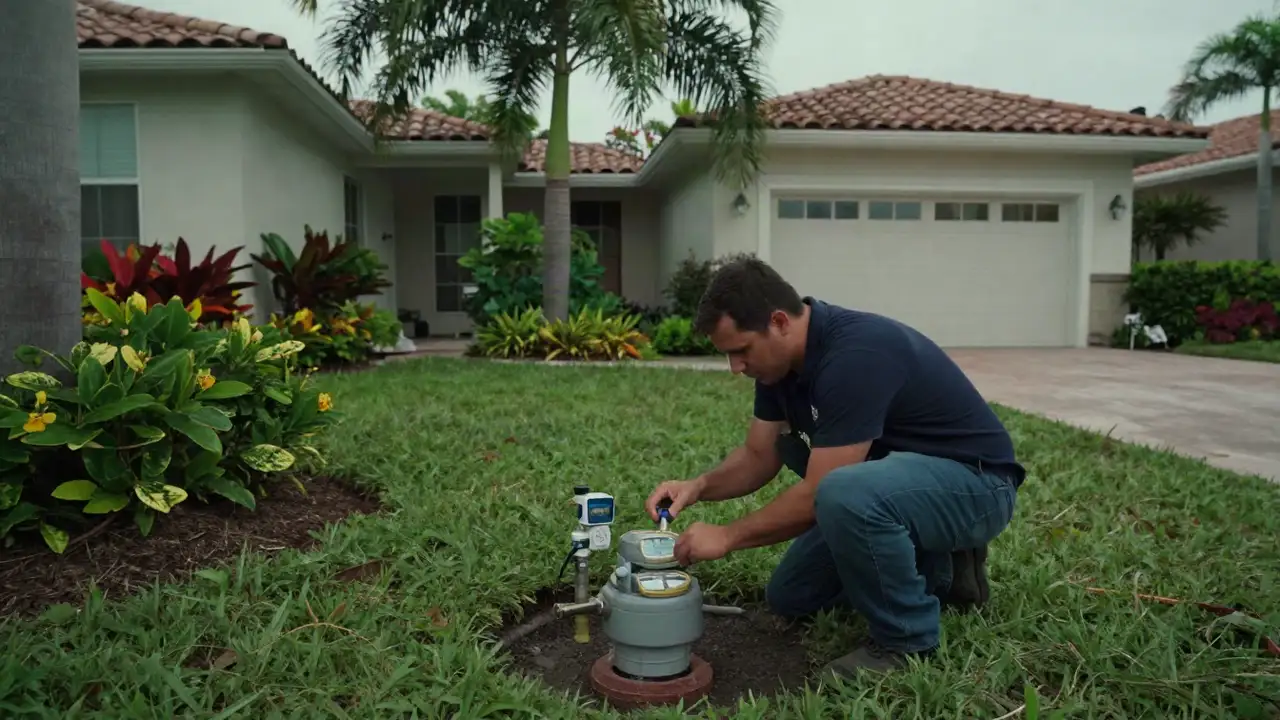
A water bill that suddenly doubles in Vero Beach is almost always caused by water you are paying for but never see - a running toilet, a stuck irrigation valve, or a hidden leak in a supply line or slab. The fastest way to confirm it is to shut every fixture in the house and watch your meter; if the low-flow dial keeps spinning, water is moving somewhere it should not. Below we walk through the five causes we find most often in Vero Beach homes, how to isolate each one in under an hour, and what leak detection actually costs here in 2026.
The short answer: where the extra water is going
A water bill suddenly high in Vero Beach FL is a symptom of volume, not of price. The city charges you by the thousand gallons, so when the number climbs by 5,000 or 10,000 gallons in a single cycle, something in your home is running when it should be off.
Here is the math that makes it click. One leaking toilet flapper - the rubber seal at the bottom of the tank - can pass 200 gallons a day without making a sound. That is 6,000 gallons a month, roughly $40 to $90 on a typical Vero Beach utility bill, and you will never hear a drip.
A pinhole leak in a half-inch copper supply line under a slab is worse. At 40 PSI it can push 1,000 gallons a day into the soil under your floor. By the time you notice a warm spot on the tile or a musty smell in the hallway, you have already paid for two billing cycles of water you never used.
So the question is not really why the bill went up. It is which of five things is leaking, and how fast you can shut it down.
How to find a water leak in your Vero Beach home
You can narrow a hidden water leak in Vero Beach down to a room or a system in about 45 minutes with nothing but your meter and a flashlight. Start with the meter test, then work outward.
- Shut everything off. No faucets, no toilets filling, no ice maker, no irrigation, no pool auto-fill. Wait 10 minutes.
- Read the meter twice. Write down the number, wait 30 minutes with nothing running, and read it again. Any movement means an active leak.
- Kill the irrigation. Find the irrigation shutoff (usually a ball valve near the hose bib or in a green box by the curb) and close it. Re-run the meter test. If the dial stops, your leak is outdoors.
- Check every toilet tank. Put a few drops of food coloring in the tank, wait 15 minutes, and look in the bowl. Color in the bowl means the flapper is passing water.
- Walk the house. Look for soft spots in the lawn, warm patches on the floor, bubbling paint, or a water heater pan that never dries.
If the meter still moves with the irrigation off and every toilet verified, you have a pressurized leak inside the walls or under the slab. That is the point where a professional water leak detection Vero Beach FL visit saves you money - we use acoustic listening equipment and thermal imaging to pinpoint the leak within a few inches instead of opening three walls hoping to get lucky.
The five causes we find most often in Vero Beach
In our experience across Vero Beach, roughly nine out of ten high-bill calls trace back to one of these five problems. They are listed in order of how often we find them.
1. A running or leaking toilet
The flapper, fill valve, or flush valve seal wears out. Hard water in Vero Beach accelerates this - the mineral scale eats rubber. A toilet that runs for 30 seconds after every flush, or that you can hear refilling at 2 a.m., is costing you money every hour.
2. Irrigation system leaks
Vero Beach irrigation runs on sandy soil with high water pressure. A broken sprinkler head, a cracked lateral line, or a stuck zone valve can dump 15 to 20 gallons a minute. If your system runs 20 minutes a day, that is 6,000 gallons a week from one broken head.
3. Slab leaks under the foundation
Homes built in Vero Beach between 1960 and 1990 often have copper supply lines running through the slab. Copper corrodes from the outside in when it sits in damp, slightly acidic soil. A slab leak is the most expensive of the five to ignore - it undermines flooring, promotes mold, and can crack tile.
4. Water heater leaks
A failing T&P valve or a cracked tank weld drips constantly. A slow drip from a water heater is easy to miss because the pan drains outside. If your water heater repair Vero Beach FL is overdue and the unit is over 10 years old, the leak is often the beginning of the end for the tank.
5. Pool auto-fill and hose bibs
A pool auto-fill valve stuck open will quietly add hundreds of gallons a day. So will a hose bib that drips behind a shrub. Both are cheap fixes and easy to overlook.
Does a running toilet really raise your water bill?
Yes - a running toilet is the single most common cause of a sudden high water bill in Vero Beach, and it is usually the cheapest to fix. A flapper that fails to seal passes water continuously from the tank into the bowl and down the drain.
Here is what that costs. A slow flapper leak passes about 200 gallons a day. A fully stuck flapper or a failed fill valve can pass 500 to 1,000 gallons a day. At Vero Beach's typical combined water and sewer rate, that is $40 to $200 added to a single monthly bill.
The fix is usually a $15 flapper and 20 minutes of work. If the toilet is older than 15 years or the tank is cracked, replacing the whole unit is often smarter. Our team handles toilet repair Vero Beach FL same-day, and we test the fill and flush cycle before we leave.
Why Vero Beach homes leak more than you would expect
Vero Beach has a specific combination of conditions that wear plumbing out faster than most of Florida. The water here is hard - typically 8 to 12 grains per gallon - which scales up fixtures and eats rubber seals. The soil is sandy and drains fast, so an underground leak can run for weeks before you see a wet spot in the yard.
Add the housing stock. Neighborhoods like Riomar and the older streets near the beach have homes from the 1950s through the 1980s, many still on original galvanized or early copper lines. Galvanized steel rusts from the inside and eventually pinholes. Copper in sandy, slightly acidic soil corrodes from the outside.
And then there is the salt air. Homes within a mile of the ocean - Central Beach, South Beach, the barrier island - see faster corrosion on exposed copper and brass fittings than homes west of the Intracoastal. If you live east of the bridge and your home is over 30 years old, you should expect to deal with at least one pinhole leak in a decade.
What leak detection costs in Vero Beach in 2026
Typical 2026 pricing in this area runs $250 to $600 for professional leak detection on a residential home, depending on how hard the leak is to isolate. That covers the diagnostic work - acoustic listening, thermal imaging, and pressure isolation - and a written location of the leak.
Here is how the numbers usually break down:
- Running toilet diagnosis and flapper replacement: $95 to $185
- Standard leak detection (visible access, single system): $250 to $400
- Slab leak detection with thermal imaging: $400 to $600
- Pinhole supply line repair after detection: $350 to $850
- Slab leak repair (reroute or tunnel): $1,800 to $4,500
Compare that to the cost of doing nothing. A slab leak running 1,000 gallons a day adds roughly $200 to $400 a month to your bill, and it will not stop on its own. Within three months you have paid for the detection twice over. If the leak has been running long enough to damage flooring or drywall, you are looking at thousands more in restoration.
We give you a flat price before we start, and we do not charge a diagnostic fee if you move forward with the repair. If the leak turns out to be a failing pipe rather than a fitting, we will walk you through whether pipe repair Vero Beach FL is enough or whether the line needs to be replaced.
Common mistakes that keep the bill high
The biggest mistake is waiting for the next billing cycle to confirm the problem. By then you have paid for another month of leaking water, and the damage underneath the slab or behind the wall has had 30 more days to spread.
Other mistakes we see regularly:
- Assuming the utility made an error. It happens, but it is rare. Check the meter reading against your bill first, then look for the leak.
- Replacing the toilet when the flapper was the problem. A $15 part fixes most running toilets. Do not replace a $400 fixture until you have verified the seal.
- Ignoring the irrigation system. Homeowners test the house and forget the yard. Irrigation leaks are the second most common cause we find.
- Patching a slab leak without finding the source. If the copper is failing in one spot, it is failing in others. A repair that ignores the pattern will be back in a year.
- Not checking the pool auto-fill. A stuck valve can add 500 gallons a day and leave no visible sign.
One more: homeowners sometimes shut off the main and leave it off for days, thinking that stops the damage. It stops the water, but the moisture already in the slab or wall keeps feeding mold. Get the leak located and repaired, then dry the area out.
When to call a professional
Call a plumber when the meter still moves after you have shut off the irrigation and verified every toilet, or when you see water where it does not belong - a warm spot on the floor, a bubbling baseboard, a lawn that stays wet for days. Those are the signs of a pressurized leak that will not fix itself.
Our team at Plumber In Vero Beach FL handles leak detection, pipe repair, and fixture replacement across Vero Beach. We find the leak, fix it, and test the line before we leave. If the leak is under the slab, we will tell you honestly whether a spot repair or a reroute is the better call for your home's age and pipe material.
We also handle the smaller stuff that drives high bills - running toilets, dripping hose bibs, failing water heater valves. If you are not sure whether the problem is worth a service call, describe what you are seeing and we will tell you over the phone.
Frequently Asked Questions
Why is my water bill suddenly so high in Vero Beach FL?
The most common causes are a running toilet (200 to 1,000 gallons a day), an irrigation leak, or a hidden supply line leak under the slab. Shut off every fixture and watch your meter - if the low-flow dial still spins, you have an active leak.
How do I find a water leak in my home in Vero Beach Florida?
Turn off all water, read your meter, wait 30 minutes, and read it again. Any movement means a leak. Then shut off the irrigation and re-test. If the meter still moves, the leak is inside the house or under the slab and needs professional detection.
Does a running toilet increase my water bill in Vero Beach FL?
Yes. A leaking flapper passes about 200 gallons a day, which adds roughly $40 to $90 a month. A fully stuck flapper can pass 1,000 gallons a day and add $200 or more to a single bill.
How much does leak detection cost in Vero Beach FL?
Residential leak detection in Vero Beach runs $250 to $600 in 2026, depending on access and whether thermal imaging is needed for a slab leak. Most homeowners recover the cost within one or two billing cycles by stopping the leak.
Will the city lower my bill if I prove I had a leak?
Sometimes. Many Florida utilities offer a one-time leak adjustment if you can show a repair receipt and a spike in usage. Call Vero Beach utility billing, explain the leak, and ask what documentation they need. Fix the leak first - the adjustment only applies to past usage.
Get help with Plumber in Vero Beach
If your water bill has jumped and you cannot find the source, we can pinpoint it fast and stop the bleeding before the next cycle. Call Plumber In Vero Beach FL at +1 (888) 721-1338 and we will get a technician out to your Vero Beach home.